Fast load change power plants vs. high efficiencyHere is a current example about increasing costs and CO2 emissions by ignoring a profitability transition. Some decades ago, nobody imagined that sun and wind energy could deliver more electricity than all the caloric power plants together. Let's look back into this time to understand the historic context: There are these peaker power plants; they work mainly at midday. They can change the load fast, so no problem replacing them on a sunny day with solar electricity. Medium-load power plants are also no problem. But maybe we will have so much photovoltaic power in the future that we will even have to switch off the base power plants. But these base load power plants have too slow a decrease to be down until midday and too slow an increase to have full power at sunset. So base load power plants are an enemy of the energy transition; they congest the grid! Really, statements like this were still being made by high-ranking Green politicians in Germany even in 2025. The conclusion: All new power plants have to be for fast load change. Who killed the electric car at the beginning of the 20th century? The lead-acid battery. My Tesla Y with lead-acid batteries would have 20 kWh capacity and 100 km range, 40 kW peak power, and the battery would need to be replaced every 6,000 km. No joke, painful experience at my first electric scooter test, 2006 to 2009 (1). The same goes for any thoughts towards grid-scale batteries. So the ideal of the fast-changing power plant was born to deal with the changes in photovoltaic and wind energy. This was the historic context about 3 decades ago. It is shocking that we are still in the first phase of the energy transition. There are 3 phases of using renewable energy from the sun and wind:
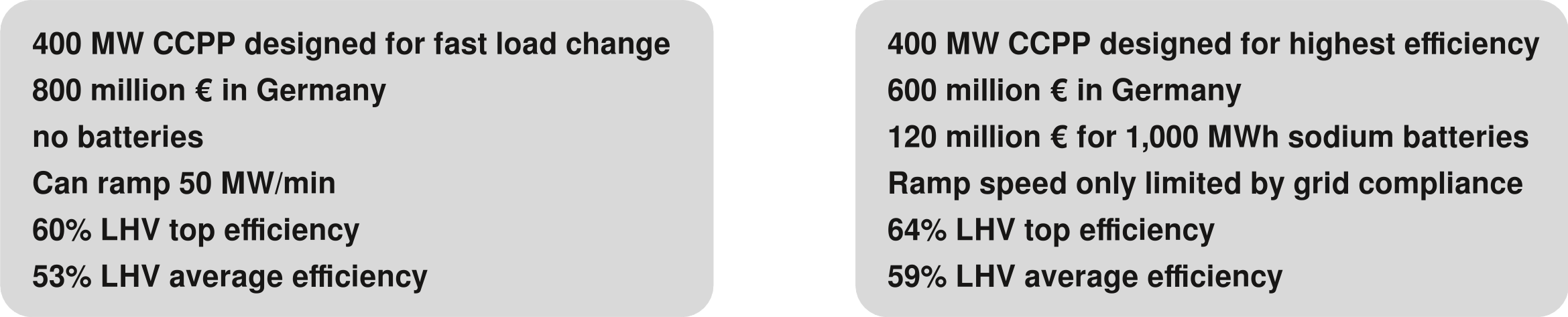 10% less CAPEX 10% less natural gas to burn is already a huge difference for the efficiency-optimized battery version. But thinking in the past, they continue to talk about fast load change power plants.
|
| Download: CORP paper PDF Slides PDF Video 189 MB |