Energy-intensive industry


I once developed a scale for off-grid solar possibilities depending on photovoltaic size, 3 Wh battery per Watt peak assumed:
  1. 10 to 100 W information and light (smartphone, laptop, LED)
  2. 200 to 300 W refrigerator (less rotten food)
  3. 500 to 1,000 W electric cooking and electric scooter
  4. 3,000 to 6,000 W air conditioner and electric car
But now is to make a big jump upwards on this scale:
  • 80,000 W to 150,000 W house in a workers village designed to contribute to the extreme electricity demand of electric-only running, energy-intensive industry.
These houses are beyond what a simple worker in a poor country could afford, even with selling much electricity to the company. It is for the company to balance house prices, the price of electricity, and the wages to pay.
Operating modes for energy intensive industry
At low battery prices, is the conversion from random electricity to 24-electricity always a win. The conversion from 24-electricity to 24×365 electricity comes at a price.
Electric-only production of cement Electric-only production of cement
But even when we correct “household” to 8,000 kWh/a, the difference between 15,000 households and 90 workers in the energy-intensive industry is two orders of magnitude.
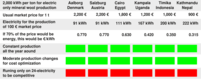
Electric-only mineral wool production Electric-only mineral wool production
There are also Cool Degree Days (CDD). Manila has as many CDD as Obergurgl, the highest permanently inhabited village in Austria, has HDD. Single glass windows and no insulation.
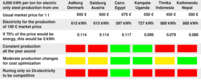
Scrap to steel by electric melting Scrap to steel by electric melting
Approximately 29% of global crude steel production is made via electric arc furnace (EAF) melting, which is the primary method for recycling steel scrap (electric melting).
PEM or AEL electrolyzer PEM or AEL electrolyzer
There had been a time when photovoltaics and batteries had been extremely expensive. No batteries are necessary at a PEM electrolyzer, making the best usage of the expensive photovoltaic.
Iron ore to steel only by electricity Iron ore to steel only by electricity
Iron ore is actually rust mixed with stones. If you want iron, you first have to remove the rust. This can be done either with carbon or hydrogen.
Fertilizer production by electricity Fertilizer production by electricity
Since the production of 1 kg of fertilizer costs 9 kWh of electricity, the least favorable ratio for replacing CO2 emissions with clean electricity is 6 kWh to avoid 1 kg of CO2.


  Cost optimization — the key to energy transition and climate protection
Paper written for the CORP.at conference March 22 to 25, 2026, in Vienna. My 2025 participation was a last-minute action, but now I have much time to prepare the paper.

Abstract
To meet the necessary cost optimization targets, we cannot hold the energy problem separate from all other problems: another major problem is housing.
Introduction
Many imaginations about our future had been created in the past with completely different parameters. Unchecked conclusions from the past endanger our future with unbearable costs.
My personal experience with a profitability transition My personal experience with a profitability transition
Birds can fly without knowing all the terms of aerodynamics. I reacted with my design change to an ongoing “profitability transition” without knowing the term at this time.
Energy transition
The long way from random electricity from sun and wind towards 24×365 electricity. Overseen profitability transitions have to be considered as major accidents.
The GEMINI principle: double usage of land
No better solar power plant, no better housing possible on the same ground is the ultimate target of the GEMINI principle.
Off-grid fast charging settlements Off-grid fast charging settlements
It can start small, somewhere in a village, with a single GEMINI house with a big PV carport and 100 kW DC charging.
Agriculture: How many square meters does a human need for his food? Agriculture: How many square meters does a human need for his food?
Mankind started as hunters and gatherers. 12,000 years ago, 500,000 m² to 2,500,000 m² per human. With the agricultural revolution, the land use was reduced by 2 magnitudes.
Conclusion
All parameters are in a constant state of change. We have to check all the parameters and predict the development for the predictable future.
References
Roland Mösl: Energy Optimised Settlements – Enabler for Necessary Civilization Targets, Graz 2025


          Energy-intensive industry: I once developed a scale for off-grid solar possibilities depending on photovoltaic size. But now is to make a big jump upwards on this scale: running, energy-intensive industry. https://climate.pege.org/2026/industry.htm